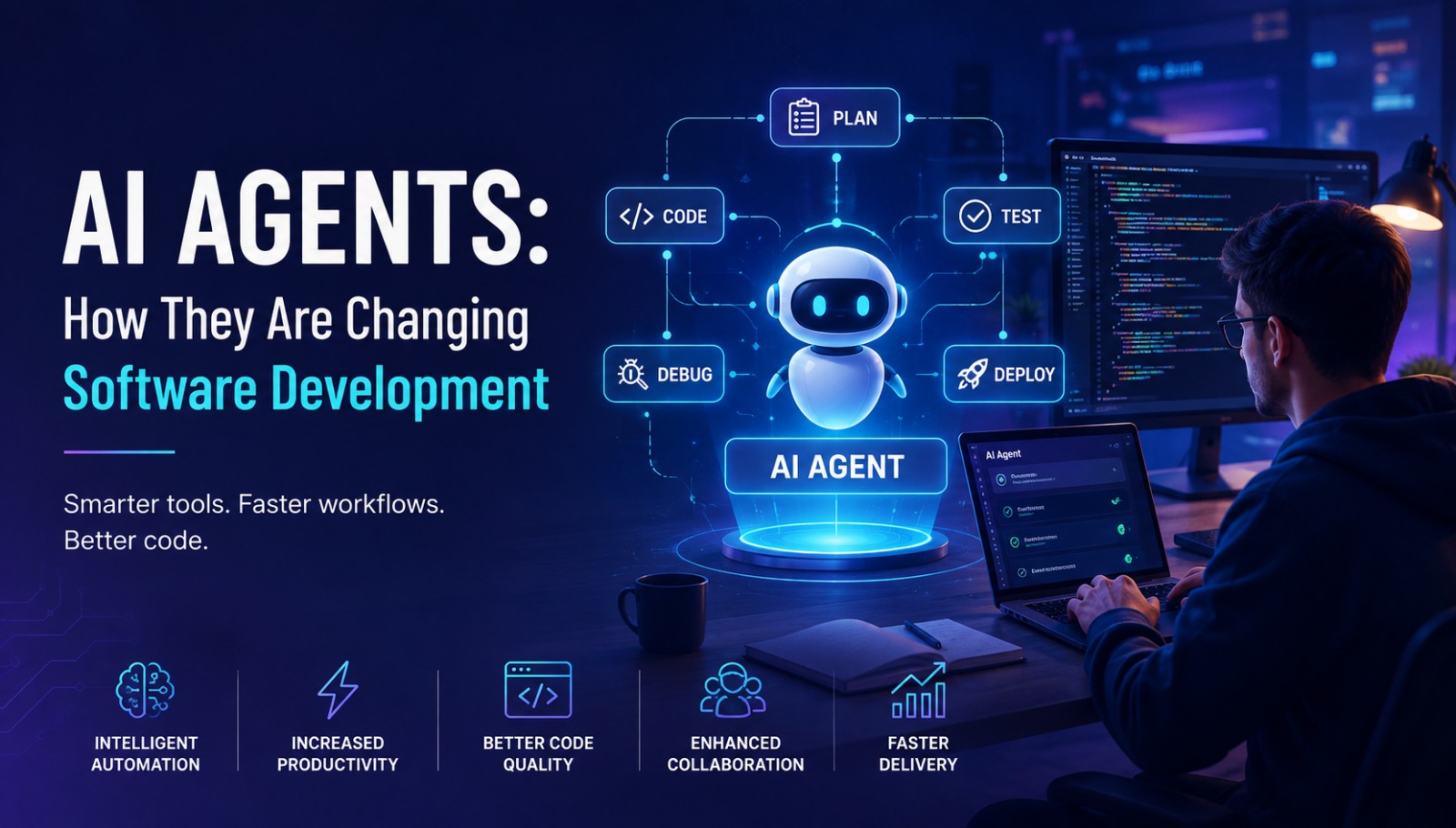
AI Agents: How They Are Changing Software Development
From writing code to completing development tasks
Introduction
Software development has changed significantly with the growth of artificial intelligence. Developers now use AI tools to understand unfamiliar code, generate functions, write tests, explain errors, and speed up everyday development work. What started as simple code suggestions is becoming more capable: AI systems can take a larger goal, decide what steps are needed, use development tools, and evaluate the results.
These systems are generally known as AI agents. Their importance comes from the way they can participate in a workflow rather than simply provide an answer. A developer can describe a feature or problem, and an agent may inspect the project, make changes, run tests, investigate failures, and continue working based on the results.
This does not mean software developers are no longer needed. Instead, it changes where developers spend their time. Repetitive work can increasingly be supported by AI, while human developers can focus on requirements, architecture, security, product decisions, and quality.
What Makes an AI Agent Different?
A typical AI assistant is built around a conversation. A developer asks a question, receives an answer, and decides what to do next. An AI agent is more action-oriented. After receiving an objective, it can break the work into smaller steps and use permitted tools to carry them out.
For example, a developer might ask an assistant to write a login function. The assistant could provide a code example. With an agent, the request could be broader: add authentication to an existing application, connect it to the database, validate user input, create tests, and check the implementation. The agent can work through the project instead of treating the request as an isolated coding question.
The important difference is not simply that an agent writes more code. It is that the system can participate in a sequence of actions and respond to what happens during that sequence.
How AI Agents Handle Development Tasks
An agent normally follows a cycle rather than producing one final answer immediately.
First, it interprets the requirement. A clear goal gives the system a better understanding of the expected outcome and the boundaries of the task.
Next, it examines the existing project. Depending on its permissions, it can inspect components, routes, services, database models, configuration files, dependencies, and tests. This context helps it avoid treating an existing application like a blank project.
The agent can then create a plan. A feature such as product search may involve finding the correct UI component, identifying the data source, adding the search input, implementing filtering, and writing tests.
After planning, it can use available tools such as a terminal, code editor, Git, testing framework, database, API, or documentation. Finally, it evaluates the result by running tests, inspecting errors, or checking the requirement. If the result is not correct, it can adjust the implementation and try again.
This creates a practical development loop: understand, plan, act, test, learn from the result, and improve.
AI Assistant vs AI Agent
An AI assistant mainly helps with a request. It can answer questions, explain code, suggest changes, and generate snippets. The developer usually decides what action to take next.
An AI agent is designed around an objective. It can work through several steps, interact with tools, and continue based on the results. The distinction is not absolute because many modern development products combine assistant and agent features.
For developers, it is useful to understand what a particular tool can actually do instead of assuming that every product called an agent has the same level of autonomy.
Where AI Agents Can Help Developers
Feature development is one of the clearest uses. An agent can help create components, API endpoints, validation logic, database queries, configuration, and tests. This is particularly useful for repetitive work where the expected pattern already exists in the project.
Debugging is another strong use case. A difficult problem may involve a frontend component, an API response, a backend service, and configuration. An agent that can inspect several related files can help connect those pieces and identify possible causes. It can also use logs and test results to narrow the search.
Testing can benefit as well. Agents can generate test cases, run existing tests, inspect failures, and suggest changes. Developers still need to decide whether the tests cover the behavior that matters.
Refactoring is another area where agents can save time. Applications often accumulate duplicated logic, outdated APIs, inconsistent naming, or large functions. An agent can help make systematic changes across multiple files, although larger changes require careful review.
Agents can also help with documentation. They can examine a codebase and prepare drafts for README files, API descriptions, setup instructions, or technical explanations.
AI Agents Across the Software Development Lifecycle
AI agents can contribute to more than the coding stage. During planning, they can help turn a broad requirement into smaller technical tasks. During implementation, they can create and modify code. During testing, they can prepare and execute automated checks. During debugging, they can investigate failures and compare possible fixes. During review, they can identify suspicious patterns or areas that deserve attention.
They can also assist with maintenance. Software projects regularly require dependency updates, repetitive changes, documentation updates, and migration work. Agent-based workflows can reduce some of that repetitive effort.
The overall shift is from AI being used mainly while typing code to AI becoming part of the wider engineering workflow.
Why Human Developers Still Matter
Automation does not remove the need for engineering judgment. A developer understands the reason behind a product requirement, the constraints of a business, and the consequences of a technical decision. An agent may understand the code it can see, but it does not automatically understand every decision behind that code.
Developers are still responsible for architecture, security, performance, scalability, user experience, and production readiness. They need to decide whether a generated solution is appropriate, not merely whether it compiles.
A useful model is simple: the human provides direction and approval, while the agent helps carry out the work. This keeps the benefits of automation without treating AI output as automatically correct.
Skills Developers Should Build
The growth of AI agents does not make programming fundamentals less important. Developers still need to understand programming concepts, data structures, algorithms, databases, APIs, authentication, testing, version control, security, and system design.
These skills provide the foundation needed to evaluate generated code. If an agent suggests an inefficient database query or an insecure authentication approach, a developer with strong fundamentals can recognize the problem.
Developers should also become comfortable with AI-assisted workflows. This includes writing clear requirements, providing useful context, defining constraints, reviewing changes, running tests, and checking important information against reliable documentation.
The valuable skill is not simply knowing how to ask an AI for code. It is knowing how to use AI while maintaining engineering quality and responsibility.
Challenges and Risks
AI agents also introduce risks.
One challenge is incorrect assumptions. An agent may misunderstand a requirement or choose a technically valid solution that does not fit the product.
Security is another concern. Generated code can contain weak validation, unsafe data handling, or incorrect authentication logic. Permissions are important too. An agent with access to a terminal, database, cloud environment, or production system may be capable of making unwanted changes. Access should therefore be limited to what the task requires.
AI systems can also provide incorrect information about libraries, frameworks, APIs, or commands. Important technical details should be verified.
Finally, an agent may lack business context. A codebase can show how something works without explaining why it was designed that way. Human knowledge is often needed to fill that gap.
How to Use AI Agents Effectively
The best results come from treating an agent as a powerful engineering tool rather than an unquestioned replacement for a developer.
Start with a specific goal. Explain what should happen, what currently happens, and any important limitations. Provide relevant project context when necessary.
Keep permissions narrow. If an agent only needs access to a project directory and test command, there is little reason to give it access to unrelated systems.
Ask the agent to verify its work. Running tests, checking builds, and examining the actual result are more reliable than accepting a generated explanation.
For complex features, break work into manageable stages. Smaller tasks make changes easier to understand and review.
Most importantly, review important changes before they reach production. AI-generated code should receive the same engineering attention as code written by another contributor.
The Future of AI-Assisted Software Development
As AI agents become more capable, development teams may use several specialized systems for different parts of a project. One system could help plan work, another could implement it, another could focus on testing, and another could review changes for security or quality.
The larger change is that software development may become more collaborative between humans and intelligent systems. Developers could spend less time on repetitive implementation and more time on product thinking, architecture, problem solving, technical leadership, and reviewing important decisions.
The most useful future is likely to be one where automation handles predictable work while humans remain responsible for goals, judgment, and accountability.
Conclusion
AI agents are changing software development by moving AI beyond simple code suggestions and into practical development workflows. They can help inspect projects, implement features, run tests, investigate bugs, refactor code, and support documentation.
Their value is not simply speed. The bigger opportunity is to reduce repetitive work and give developers more time for problems that require human understanding and judgment.
At the same time, agents need boundaries. Generated code can be wrong, permissions can be excessive, and technical decisions still require review. Developers who understand both software engineering fundamentals and AI-assisted workflows will be better prepared to use these systems effectively.
The future of software development is not about choosing between humans and AI. It is about combining human expertise with increasingly capable tools to build software more efficiently, carefully, and intelligently.