What does AI in healthcare actually mean?
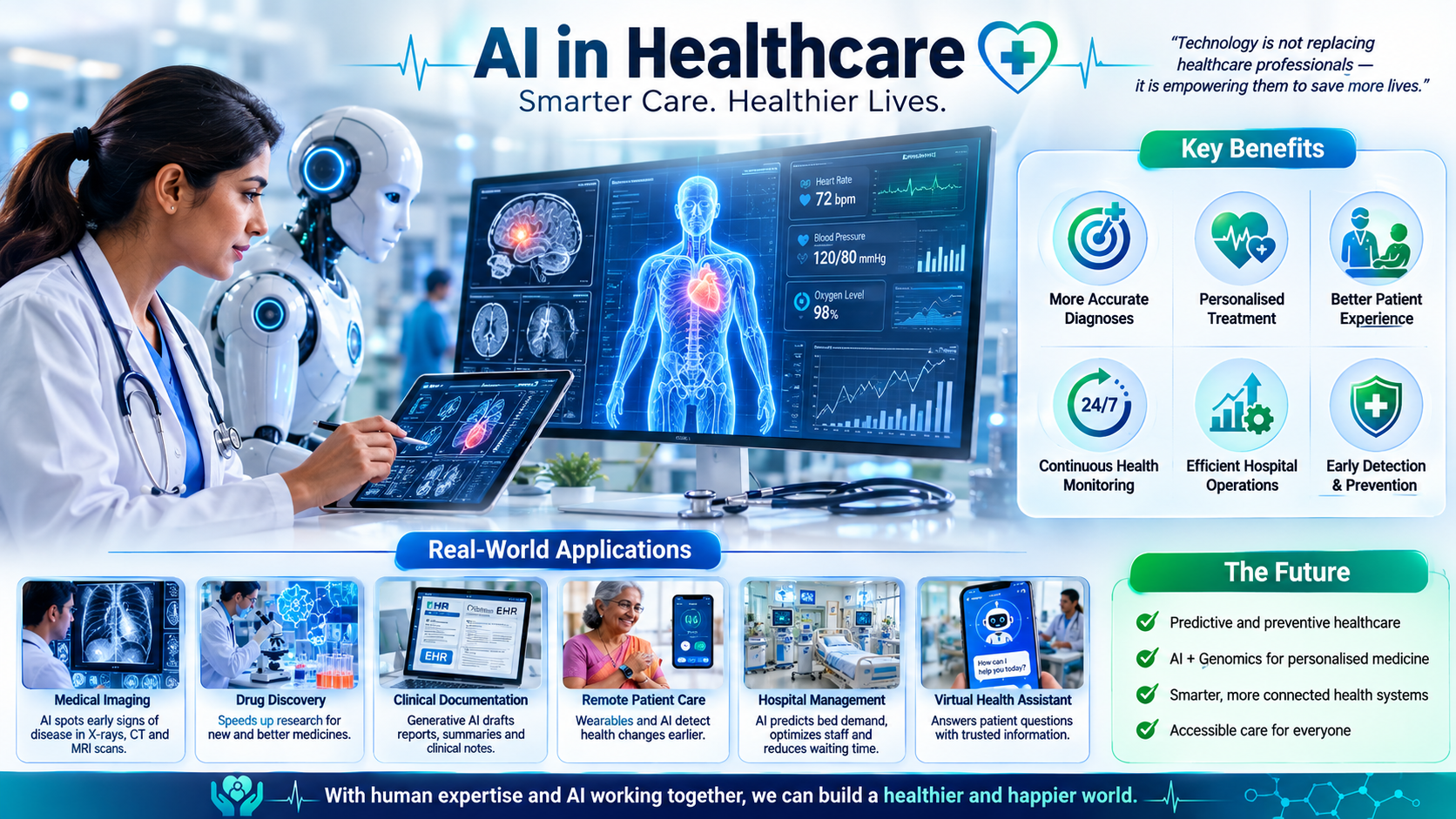
Artificial intelligence in healthcare refers to software systems that can analyse medical data, recognise patterns, generate predictions, support decisions, and automate selected tasks. The technology includes machine learning, deep learning, natural language processing, computer vision, and generative AI. Rather than replacing clinicians, the strongest use cases are designed to extend human capability: helping healthcare professionals find important information faster, identify risks earlier, and spend more time on complex clinical judgement and patient care.
Why is healthcare such an important area for AI?
Healthcare produces enormous amounts of information, from medical images and laboratory results to clinical notes, prescriptions, wearable-device signals, and operational data. A human team cannot manually review every data point at the same speed or scale as a well-designed AI system. AI can help organise this information, surface relevant patterns, and reduce repetitive work. This is especially valuable when healthcare systems face rising demand, limited staff capacity, increasing costs, and pressure to deliver more personalised care.
Where is AI already being used in healthcare?
AI is being applied across clinical care and hospital operations. Common examples include analysing radiology images, predicting patient deterioration, assisting with clinical documentation, supporting drug discovery, prioritising patient queues, detecting anomalies in laboratory data, and powering virtual assistants. In each case, the value depends on the quality of the data, the clinical workflow, and the safeguards surrounding the system.
How can AI improve medical diagnosis?
Diagnostic AI can compare a patient's data with patterns learned from large datasets. In medical imaging, computer-vision models can highlight suspicious regions in X-rays, CT scans, MRIs, retinal images, or pathology slides. In other settings, predictive models can combine symptoms, vital signs, laboratory values, and medical history to estimate risk. The practical benefit is not simply speed. A useful system can act as a second set of eyes, help prioritise urgent cases, and draw attention to findings that deserve closer review.
How does AI support personalised treatment?
Traditional treatment pathways often begin with what works for the average patient. AI can support a more individual approach by analysing factors such as medical history, test results, disease progression, medication response, lifestyle data, and sometimes genomic information. A clinical decision-support system may use these signals to estimate which treatment option is more likely to help a particular patient. The final choice still requires clinical assessment because predictions do not capture every personal, ethical, or medical consideration.
What role does generative AI play in hospitals and clinics?
Generative AI can work with unstructured information such as clinical notes, discharge summaries, referral letters, medical guidelines, and patient questions. It can draft documentation, summarise long records, convert technical language into patient-friendly explanations, and help clinicians search large knowledge collections. When connected to trusted healthcare sources, retrieval-based systems can also ground answers in approved documents. However, generated text must be reviewed because a fluent answer can still contain an incorrect or unsupported statement.
Can AI help with remote monitoring and preventive care?
Yes. Wearables, home-monitoring devices, and connected medical equipment can continuously collect measurements such as heart rate, activity, sleep, glucose, blood pressure, or oxygen saturation. AI can analyse these time-series signals and identify changes that may require attention. This creates an opportunity to move from reactive care toward earlier intervention. The challenge is avoiding excessive alerts: a useful monitoring system must distinguish meaningful change from normal variation so that clinicians and patients are not overwhelmed.
How can AI reduce administrative workload?
A large share of healthcare work happens outside direct treatment. Staff manage appointments, referrals, coding, billing, prior records, forms, documentation, and communication. AI can automate or assist with repetitive parts of these processes. Speech recognition can turn consultations into draft notes, language models can summarise records, and predictive systems can help forecast demand or identify likely appointment no-shows. AI can reduce administrative workload by streamlining routine tasks and improving operational efficiency. Human review remains important so that mistakes are identified and corrected quickly.
What are the biggest risks of using AI in healthcare?
The main risks are inaccurate outputs, biased predictions, weak data quality, privacy breaches, poor integration into clinical workflows, and over-reliance on automated recommendations. A model trained on data that does not represent the population where it is deployed may perform unevenly across patient groups. Generative AI may also produce convincing information that is not supported by evidence. Because healthcare decisions can have serious consequences, systems need stronger validation and oversight than ordinary consumer AI applications.
Clinical safety — predictions and generated content must be tested against realistic medical scenarios.
Bias and fairness — performance should be evaluated across relevant patient groups, with group-level results considered alongside overall accuracy.
Privacy and security — health data requires strict access control, secure storage, and responsible data handling.
Explainability — clinicians need enough evidence to understand why a recommendation or alert deserves attention.
Human oversight — high-impact decisions should remain reviewable by qualified healthcare professionals.
Why are privacy and data governance critical?
Healthcare information is highly sensitive. AI systems may need access to medical histories, images, prescriptions, test results, or other personal data, so organisations must control who can access information, why it is being used, how long it is retained, and where it is processed. Data should be minimised to what is necessary for the task. Strong governance also includes audit logs, role-based permissions, security testing, incident procedures, and clear rules for vendors and third-party models.
How should healthcare organisations evaluate an AI system?
Evaluation should begin with a clearly defined clinical or operational problem. Teams should test the system on representative data, compare its performance with the existing process, and measure more than headline accuracy. Depending on the use case, important measures may include sensitivity, specificity, false-positive rate, false-negative rate, calibration, response time, usability, and impact on staff workload. After deployment, performance should continue to be monitored because patient populations, workflows, and data can change.
Will AI replace doctors, nurses, or healthcare professionals?
AI is more likely to change tasks than eliminate the need for healthcare professionals. Machines are strong at processing large datasets, detecting statistical patterns, and generating first drafts. Healthcare professionals contribute clinical reasoning, empathy, ethical judgement, accountability, physical examination, and an understanding of the patient's broader situation. The most effective future model is therefore collaborative: AI handles suitable computational work while people make responsible decisions and maintain the human relationship at the centre of care.
What does responsible AI adoption look like in healthcare?
Responsible adoption starts with a narrow problem and a measurable benefit. Organisations should involve clinicians, patients, data specialists, security teams, legal or compliance experts, and operational staff early in the project. The AI should be tested in the environment where it will actually be used, with clear escalation paths when confidence is low or data is missing. Users should know when AI is involved, what the system can and cannot do, and who remains accountable for the final action.
What is the future of AI in healthcare?
The next phase of AI in healthcare will increasingly connect multiple types of clinical information. A single system may combine medical images, structured records, clinician notes, laboratory data, genomics, and real-time signals from connected devices. Multimodal models could help clinicians build a more complete view of a patient, while AI agents may coordinate low-risk administrative workflows. At the same time, healthcare organisations will demand stronger evidence, transparency, security, and monitoring before trusting systems in high-impact settings.
What should healthcare teams focus on first?
The best starting point is not 'Where can we use AI?' but 'Which healthcare problem is important, measurable, and suitable for AI assistance?' A successful project needs reliable data, a clear workflow owner, realistic evaluation cases, defined safety boundaries, and a plan for human review. Starting with a focused use case makes it easier to demonstrate value, identify failure modes, and build trust before expanding to more complex applications.