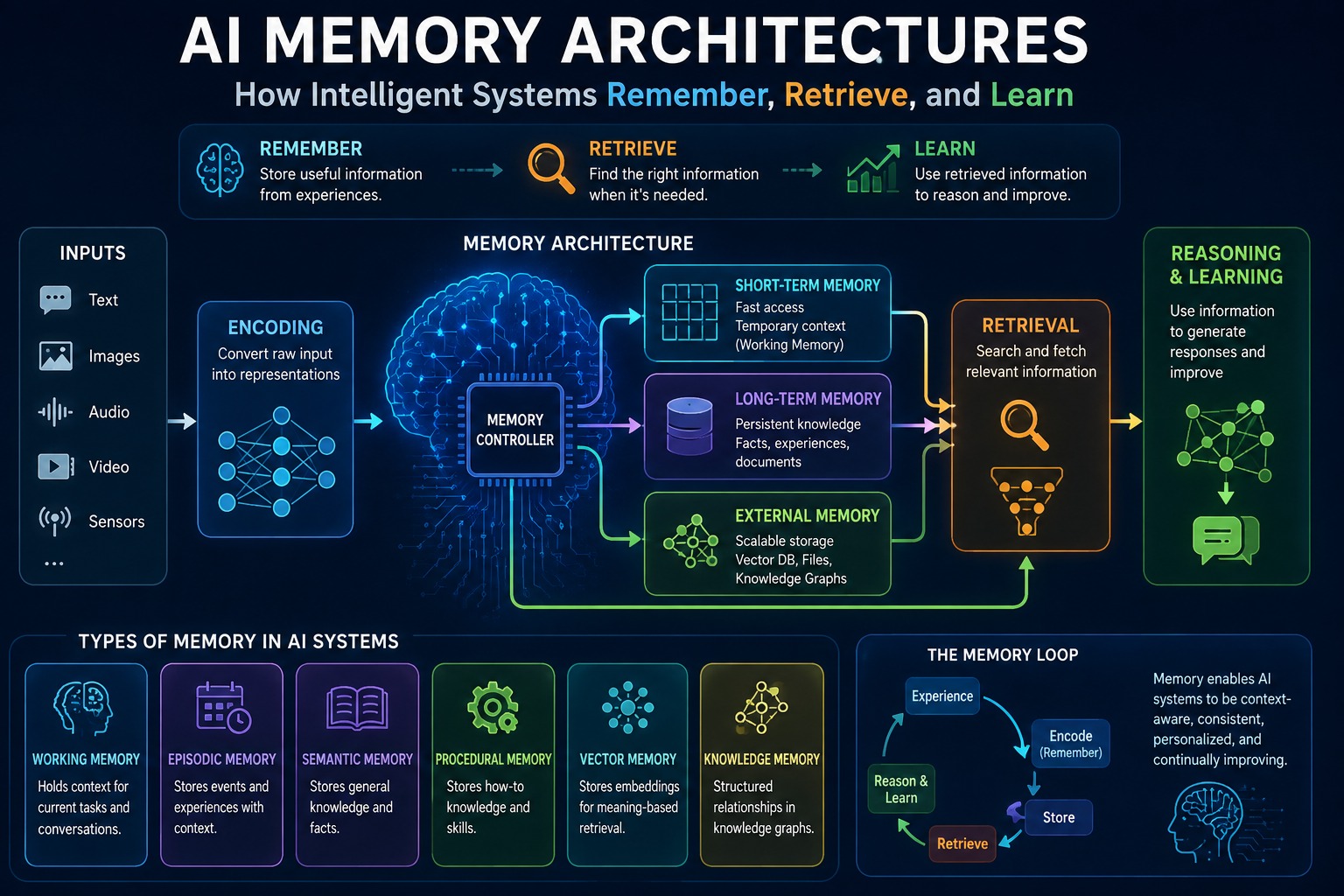
AI Memory Architectures: How Intelligent Systems Remember, Retrieve, and Learn
1. Introduction
Large Language Models (LLMs) can write code, answer questions, summarize documents, and assist with complex tasks. However, their ability to maintain information across separate interactions is limited by the context available to them.
A conversation can contain useful details about a person, project, or task, but those details do not automatically become permanent knowledge for the model.
This creates a key engineering challenge:
How can an AI system preserve useful information, find it later, and use it appropriately without remembering everything?
AI memory architectures address this problem by adding a memory layer around the model. This layer can capture important information, organize it, retrieve relevant details, and revise or remove information as circumstances change.
Memory becomes particularly valuable in AI assistants and autonomous agents, where the system may need to work with the same user, project, or environment over an extended period.
2. What Is AI Memory?
AI memory is a system that enables an AI application to maintain useful information beyond a single interaction.
Instead of processing every request independently, the system can preserve selected information and bring it back when a future task requires it.
A typical memory pipeline can be viewed as:
Interaction → Identify Useful Information → Save → Retrieve → Add to Context → Generate Response → Update
For example, consider an AI development assistant working on a software project. During an earlier conversation, it discovers that the project uses TypeScript and PostgreSQL.
Several weeks later, the developer asks it to create another backend service. If that project information has been retained, the assistant can use it to produce a solution that better matches the existing technology choices.
The LLM supplies the reasoning and generation capabilities, while the memory system provides continuity between interactions.
3. Types of AI Memory
AI memory can be divided into several categories. Each category serves a different purpose.
Short-Term Memory
Short-term memory contains information that is relevant to the current conversation or task.
For example, while building an API, an AI might need to remember decisions such as:
The backend uses Node.js
Authentication uses JWT
MySQL is the database
The current issue is related to authentication
This information is useful while the task is active but may not need to be retained permanently.
Working Memory
Working memory contains temporary information that helps an AI complete an ongoing operation.
An autonomous coding agent might maintain a state such as:
Task: Resolve authentication failure
File: auth.js
Possible cause: Incorrect token expiration
Next step: Inspect authentication middleware
Once the task has been completed, much of this temporary state can be discarded.
Long-Term Memory
Long-term memory contains information that remains useful across multiple sessions.
Examples include:
User preferences
Project details
Previous decisions
Important facts
Frequently used workflows
Unlike working memory, this information is intended to remain available when a new session begins.
Episodic Memory
Episodic memory records experiences or events that occurred previously.
For example:
A previous deployment failed because an environment variable was missing.
If a similar deployment problem appears later, an AI agent can use the earlier experience as a reference when deciding what to investigate.
Semantic Memory
Semantic memory focuses on facts and concepts rather than individual events.
For example:
React Native → Cross-platform mobile framework
MySQL → Relational database
JWT → Token-based authentication
These facts can provide background knowledge that helps an AI make better decisions.
Procedural Memory
Procedural memory represents knowledge about how to perform a task.
For example, an agent could retain a successful deployment workflow:
Deploy Application → Run Tests → Build → Start PM2 → Configure Nginx → Verify API
Remembering successful procedures allows an agent to reuse established workflows rather than reconstructing the process every time.
4. How AI Memory Works
A practical AI memory architecture can be understood through four core operations:
Write → Store → Retrieve → Update
1. Write
The system first examines an interaction and determines whether there is information worth retaining.
For example, an AI might identify:
The project uses TypeScript for backend development.
2. Store
The selected information is converted into an appropriate memory representation and saved in a storage system.
The stored information may later be associated with metadata such as its source, importance, timestamp, or confidence.
3. Retrieve
When a new request arrives, the system searches its memory for information that could help answer the request.
Instead of loading every stored memory, it attempts to identify the most relevant pieces.
4. Update
Memory should not remain static forever. New interactions may confirm an existing memory, modify it, or show that it is no longer accurate.
For example:
Previous: User prefers Python
Later: User has moved to TypeScript
The memory layer needs to recognize that the newer information may supersede the older preference.
This creates a continuous cycle:
Experience → Memory → Retrieval → Action → New Experience
Such a cycle is especially important for AI agents that operate continuously.
5. Memory Storage Technologies
The memory layer needs a place to persist the information it creates. The storage technology depends on the type of information and how it will be retrieved.
Relational Databases
Traditional databases such as MySQL or PostgreSQL can store structured memories.
A memory record might contain fields such as:
User ID
Memory type
Content
Timestamp
Importance
Confidence
Expiration status
This approach works well when memories need predictable structure and transactional updates.
Document Stores
Document-oriented databases can store more flexible memory objects.
This can be useful when different memory types require different fields or structures.
Vector Databases
Vector storage is useful when retrieval depends on semantic similarity.
Text can be transformed into numerical embeddings. When the AI receives a new request, the request can also be embedded and compared with stored vectors to identify semantically related memories.
For example:
Stored memory:
"Developer prefers TypeScript for backend projects."
New request:
"Create a new server using the developer's preferred backend language."
A semantic search system can identify the earlier memory even though the wording is different. Hybrid Storage
Real-world systems can combine several approaches.
A relational database may store structured metadata, while a vector index handles semantic retrieval.
This allows the architecture to use both exact filtering and meaning-based search.
6. AI Memory vs RAG
AI memory and Retrieval-Augmented Generation (RAG) are related, but they solve different problems.
RAG primarily helps an AI access external information.
For example, a RAG system might retrieve information from:
Company documentation
PDFs
Databases
Knowledge bases
Internal websites
Memory focuses on continuity.
It can preserve information about:
Previous interactions
User preferences
Past decisions
Earlier experiences
Ongoing projects
A simple way to distinguish them is:
RAG → "What information can I retrieve?
Memory → "What do I know about this ongoing interaction or experience?"
The two approaches can also work together. A system might use RAG to retrieve external knowledge while using memory to understand the user's previous decisions and preferences.
The distinction is important because memory is not simply a larger document retrieval system. It involves deciding what information deserves to persist and how that information should change over time. The source similarly describes RAG as providing external knowledge while memory provides continuity and experience.
7. AI Memory in Autonomous Agents
Memory becomes much more powerful when combined with autonomous agents.
A basic chatbot can respond to an individual request. An agent, however, may perform a sequence of actions, observe the results, and use those results to decide what to do next.
Consider a software development agent.
It encounters an Android build problem:
Problem: Android build fails
Investigation: NDK configuration is incompatible
Action: Update the NDK configuration
Result: Build succeeds
The agent can store this experience.
If a similar build problem occurs later, the stored experience can become one of the signals used during troubleshooting.
This creates a feedback loop:
Experience → Store → Retrieve → Decide → Act → Observe → Store Again
Memory therefore gives agents something beyond reasoning: continuity across actions and experiences.
8. The Hard Problems
The biggest challenge in AI memory is not simply finding somewhere to store data.
The difficult question is:
What should the system remember, and what should it ignore?
What Should Be Remembered?
Not every interaction deserves permanent storage.
For example:
The weather is hot today.
This may have little value in a future conversation.
But:
I prefer TypeScript for backend development.
could remain useful for many future tasks.
A memory system therefore needs a way to estimate whether information has lasting value.
Handling Outdated Information
Memories can become incorrect as circumstances change.
Projects evolve. Preferences change. Requirements are replaced.
A robust memory system may therefore need:
Recency information
Confidence levels
Memory updates
Staleness detection
Expiration rules
Without these mechanisms, an AI could continue relying on information that is no longer valid.
Resolving Conflicting Memories
Different interactions can produce contradictory information.
For example:
Older memory: User prefers Python.
Newer memory: User now prefers TypeScript.
The system must decide whether the new information replaces the old one, whether both should remain, or whether additional evidence is required.
This makes memory management partly a problem of trust, recency, and confidence.
Avoiding Memory Overload
More memory does not automatically produce a smarter AI.
If hundreds or thousands of irrelevant memories are retrieved for every request, the model's context can become crowded with information that does not help the current task.
Possible solutions include:
Ranking memories
Summarizing older information
Compressing stored content
Assigning importance scores
Expiring low-value memories
Deleting unnecessary information
Privacy and Security
Persistent memory also introduces a serious data-management responsibility.
When an AI stores information about users or organizations, developers need to consider:
What information is collected?
Who can access it?
How long is it retained?
Can users remove it?
How is sensitive information protected?
A useful memory architecture therefore needs to balance intelligence with privacy and user control.
9. Conclusion
AI memory is developing into an important architectural component of modern intelligent systems.
It is not simply a mechanism for saving chat history. A useful memory system must decide what information is valuable, preserve it in an appropriate form, retrieve it at the right moment, revise outdated information, and remove memories that no longer serve a purpose.
The progression can be viewed as:
LLM → Context → RAG → Memory → Agents → Adaptive AI
An LLM provides reasoning and generation. RAG expands access to external information. Memory introduces continuity, while autonomous agents use that continuity to build on previous actions and experiences.