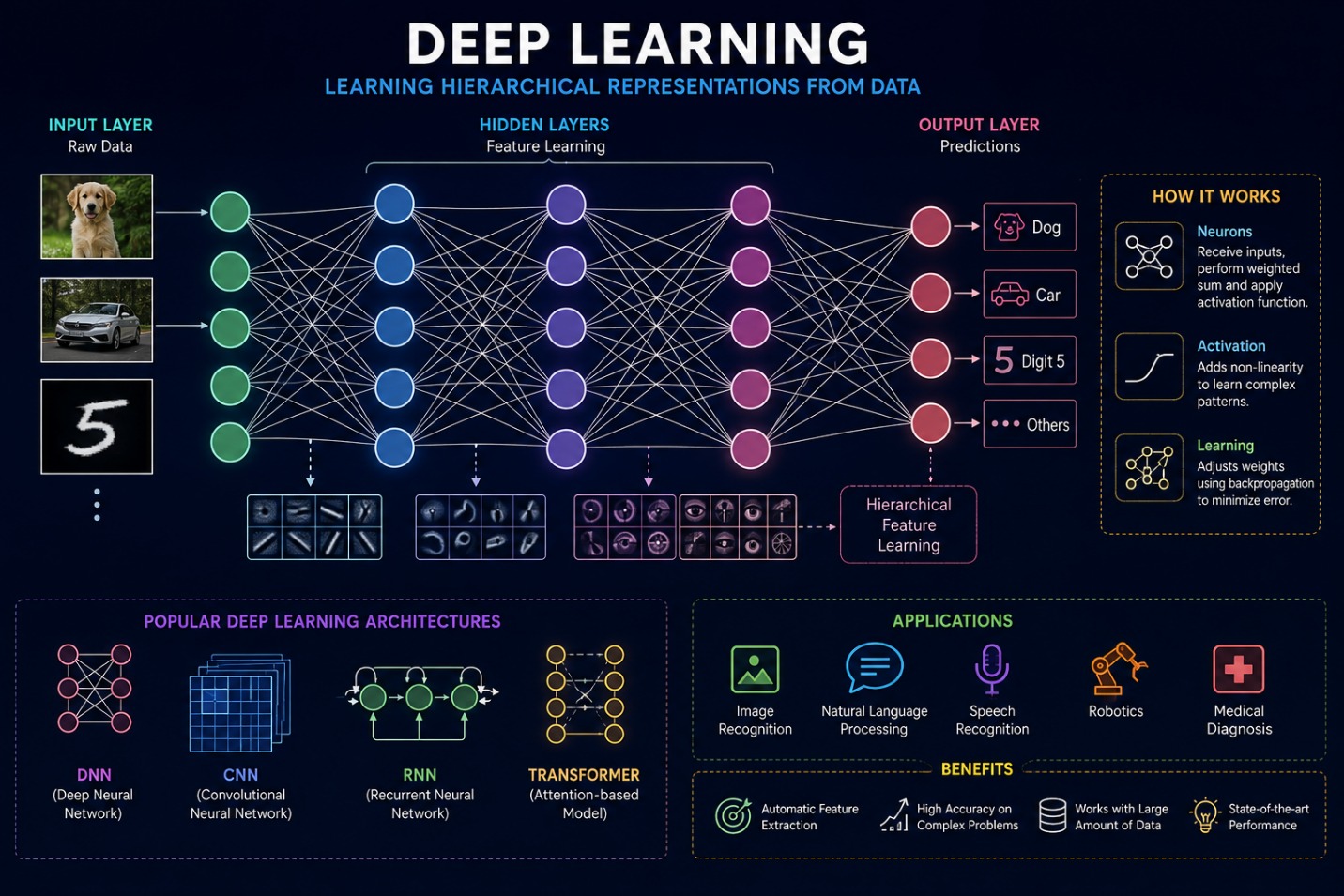
Overview of Convolutional Neural Networks
A Convolutional Neural Network (CNN) represents a specialized class of deep learning architectures tailored primarily for grid-like topology data, most notably two-dimensional images. Unlike traditional artificial neural networks that require manual feature engineering, CNNs autonomously discover and extract hierarchical patterns directly from raw training inputs. As data flows deeper through the network hierarchy, lower-level abstractions—such as primitive edges and directional gradients—gradually synthesize into complex, high-level representations like recognizable object components and complete structures.
Core Architectural Workflow
Instead of establishing dense, full connectivity between every input pixel and subsequent neurons, CNNs process information via localized receptive fields. This localized approach drastically cuts down parameter overhead while safeguarding critical spatial topologies.
1. Feature Extraction via Convolution
The foundational step relies on localized matrix operators known as kernels or filters. These kernels slide across the input matrix, executing dot-product operations over specific local neighborhoods to generate a specialized output matrix called a feature map.
Early-stage layers typically isolate fundamental geometric details like lines and angles.
Deeper tiers integrate these elemental shapes to map intricate textures and holistic object configurations.
2. Non-linear Activation (ReLU)
To ensure the network can map complex, non-linear real-world phenomena, mathematical activation functions follow convolution steps. The Rectified Linear Unit (ReLU) serves as the prevailing industry standard.
Expressed mathematically:
$$ReLU(x) = max(0, x)$$
By nullifying negative inputs and allowing positive values to pass unimpeded, ReLU injects the necessary non-linear capacity into the learning pipeline.
3. Spatial Dimensionality Reduction (Pooling)
Pooling layers systematically shrink the spatial dimensions (width and height) of preceding feature maps. Utilizing techniques like Max Pooling—which extracts the peak numerical value from a defined sub-region—the architecture minimizes computational expenses while building invariance to minor positional shifts of features within the image frame.
4. Dense Mapping and Decision Making
Once multiple convolutional-pooling cycles isolate and refine relevant visual markers, the multi-dimensional feature maps are flattened into vectors. Fully connected (dense) layers then interpret these compiled features to drive final inferences. For categorization tasks spanning multiple classes, a Softmax activation function scales outputs into normalized probability distributions.
Key Hyperparameters and Their Functions
Real-World Implementation Domains
CNN frameworks anchor numerous modern technological breakthroughs across diverse industries:
Computer Vision Systems: Powers automated identification tasks, including object detection pipelines, semantic image segmentation, facial biometrics, and general categorization.
Medical Diagnostics: Assists clinical professionals by inspecting radiological scans (such as MRIs, X-rays, and CT datasets) for structural anomalies or pathologies.
Autonomous Navigation: Drives perception subsystems in self-driving cars to spot pedestrians, lane guidelines, traffic signals, and surrounding obstacles.
Acoustic Processing: Analyzes time-frequency representations (spectrograms) to handle speech recognition and automated audio event detection.
Quality Assurance: Automates manufacturing lines to catch micro-defects and structural flaws in industrial goods.
Summary
The primary strength of a CNN stems from its capacity to self-learn spatial features automatically. Through sequential processing stages—convolutional extraction, non-linear activation, spatial pooling, and dense decision classification—CNNs remain the foundational backbone of contemporary computer vision and automated image intelligence.
Would you like me to adjust the vocabulary level further or format this into a different template (such as slide notes or markdown tables) to fit your submission format?