Federated Learning: Rethinking AI Training in a Privacy-Conscious World
Artificial intelligence has become a driving force behind modern digital transformation. From recommendation engines and fraud detection systems to predictive maintenance and medical diagnosis, AI is helping organizations solve problems that were once impossible to automate. Yet, behind every successful AI model lies one essential ingredient—data.
For many organizations, data is both their greatest asset and their greatest responsibility. Customer records, financial transactions, medical histories, and operational data contain valuable insights, but they also carry significant privacy obligations. Sharing this information across organizations or storing it in one centralized location isn't always practical, secure, or legally permissible.
This challenge has encouraged researchers and technology companies to rethink how machine learning models are trained. Instead of moving data to the model, why not move the learning process closer to the data?
That simple idea forms the foundation of Federated Learning.
A Different Way to Train AI
Traditional machine learning usually begins by collecting information from different sources into one central repository. Engineers clean the data, prepare it for analysis, and train models using powerful servers or cloud infrastructure.
While this centralized workflow has delivered impressive results, it also creates several concerns. Every time sensitive information is copied, transferred, or stored in multiple locations, the potential attack surface increases. Organizations must also consider compliance requirements, customer expectations, and operational costs associated with managing large datasets.
Federated Learning approaches the problem differently.
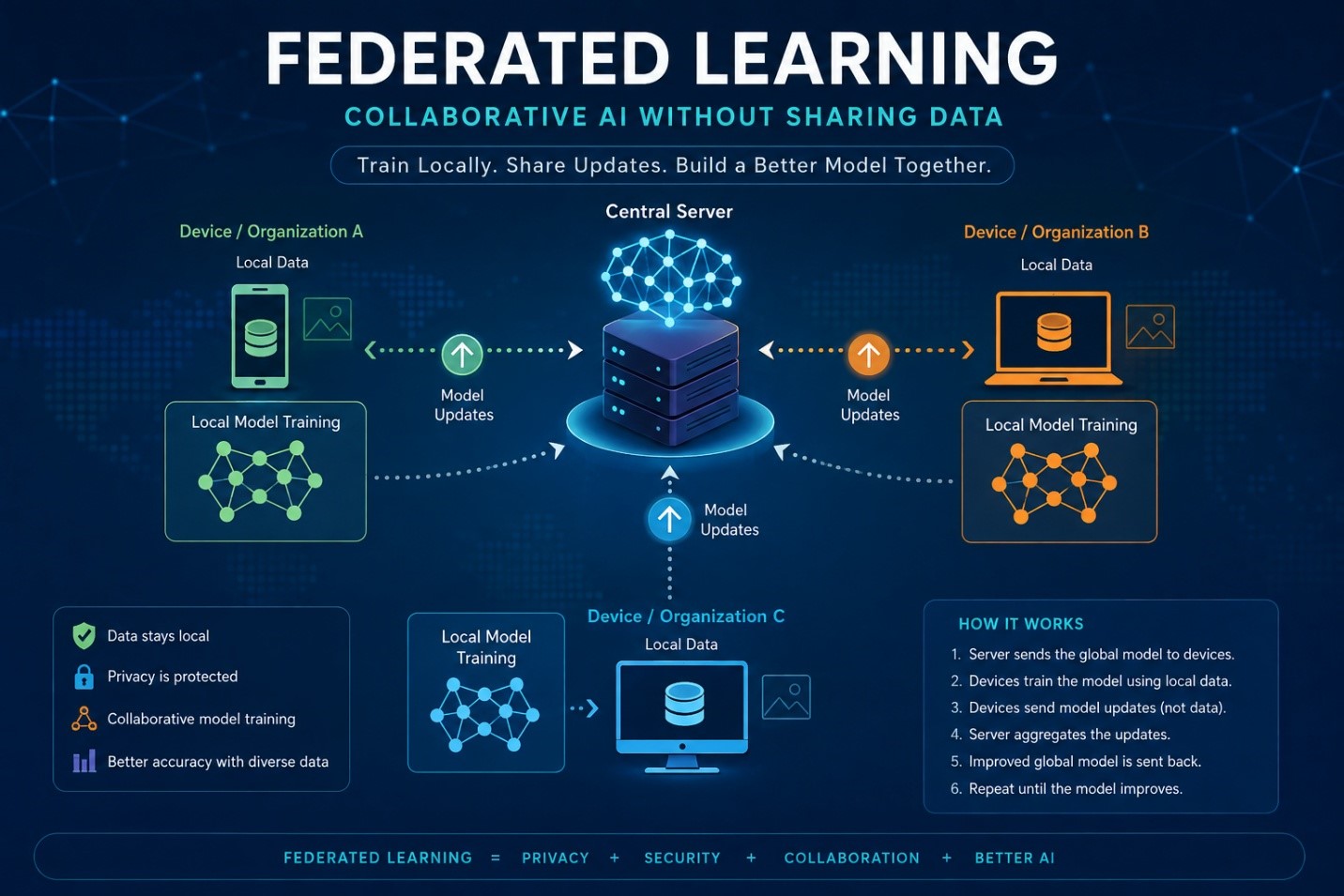
Instead of transferring datasets, each participating device or organization performs training locally. The knowledge gained during local training is shared in the form of model updates, while the underlying data remains inside its original environment. These updates are combined to improve a common model that benefits every participant.
In essence, organizations collaborate on intelligence rather than exchanging confidential information.
Why This Matters
Digital privacy has become a business priority rather than simply an IT concern. Customers expect companies to protect their personal information, and regulators expect organizations to demonstrate responsible data handling practices.
Federated Learning supports these expectations by reducing the need for centralized data collection. Sensitive records stay under the control of their owners, lowering the likelihood of unnecessary exposure while still enabling collaborative innovation.
This makes the approach especially valuable for industries where confidentiality is fundamental to everyday operations.
A Practical Business Scenario
Consider several regional hospitals that want to improve the accuracy of an AI system capable of detecting early signs of a rare disease.
Each hospital has accumulated years of patient information, but legal restrictions prevent them from sharing medical records with one another.
Rather than abandoning the collaboration, each hospital trains the AI model using its own secure database. After training, only mathematical updates describing what the model has learned are transmitted to a coordinating server. The server combines contributions from every hospital and distributes an improved model back to all participants.
No patient files leave the hospitals, yet every institution benefits from knowledge learned across the network.
This collaborative approach creates value without compromising confidentiality.
How the Learning Process Takes Place
Although the technology behind Federated Learning is sophisticated, its workflow can be understood through a few simple stages.
A global machine learning model is prepared and distributed to participating systems. Each participant performs training using its own local information and produces an updated version of the model. These updates are transmitted to a central coordinator, which merges them into a stronger global model. The improved model is then redistributed, allowing every participant to continue training from a better starting point.
By repeating this cycle several times, the collective model gradually becomes more accurate without requiring centralized access to raw data.
Benefits Beyond Privacy
Privacy is often described as the primary advantage of Federated Learning, but its value extends well beyond protecting sensitive information.
Organizations gain greater control over their own data assets while continuing to participate in collaborative AI initiatives. Because raw datasets remain local, network bandwidth requirements can also decrease compared with transferring massive databases to cloud environments.
Federated Learning additionally supports compliance efforts in sectors governed by strict privacy regulations, making it easier for businesses to balance innovation with legal obligations.
Another important advantage is trust. Partners are often more willing to collaborate when they know proprietary or confidential information never leaves their own infrastructure.
Industries Exploring Federated Learning
Healthcare providers use Federated Learning to improve diagnostic systems while protecting patient confidentiality.
Financial institutions apply similar principles to strengthen fraud detection without exposing customer transactions.
Manufacturing companies investigate collaborative predictive maintenance models that learn from equipment operating in different facilities.
Smart devices, wearable technology, connected vehicles, and industrial IoT platforms also benefit from learning directly on devices rather than constantly uploading user information to cloud servers.
As connected systems continue to grow, decentralized learning is becoming increasingly relevant across multiple industries.
Challenges That Engineers Should Consider
Like any emerging technology, Federated Learning introduces engineering challenges that require careful planning.
Data collected by different organizations rarely follows identical patterns. Variations in quality, size, and distribution can affect model performance and increase training complexity.
Communication efficiency also becomes important because many devices must exchange model updates throughout the training process. Slow networks or unreliable connections can delay synchronization.
Finally, protecting model updates themselves remains an active area of research. Techniques such as secure aggregation and differential privacy are commonly combined with Federated Learning to strengthen overall security.
Looking Ahead
As organizations continue integrating AI into business operations, privacy-aware learning methods will become increasingly important. Customers expect transparency, regulators demand accountability, and businesses require intelligent systems capable of learning from distributed environments.
Federated Learning offers a practical path toward achieving these objectives simultaneously. Rather than treating privacy as a limitation, it transforms privacy into part of the system's design.
Although the technology continues to evolve, its underlying principle is straightforward: valuable insights can be shared without exposing the information that created them.
Conclusion
Federated Learning represents an important shift in the evolution of artificial intelligence. Instead of relying entirely on centralized datasets, it enables organizations to collaborate while maintaining ownership and control of their information.
For businesses investing in secure, scalable, and responsible AI solutions, this approach provides a compelling balance between innovation and privacy. As adoption increases across healthcare, finance, manufacturing, and connected technologies, Federated Learning is likely to become a fundamental component of next-generation AI systems rather than an experimental concept.