How does RAG actually improve an AI system?
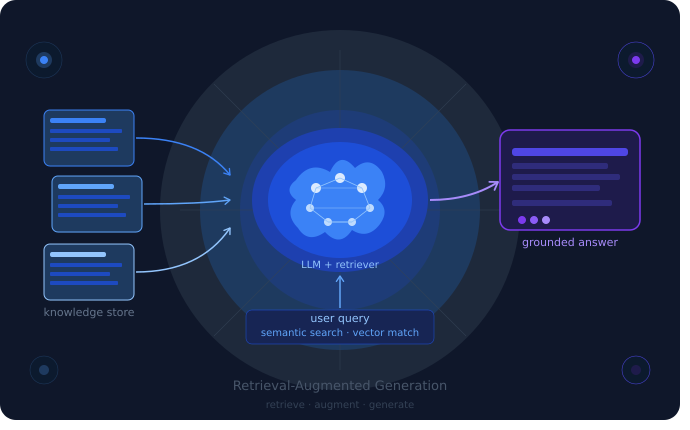
When a large language model answers a question purely from its training data, it works like someone answering from memory — confident, but potentially outdated or just wrong. RAG changes that by connecting the model to a live knowledge source before generating a response. The system first searches your documents or database for the most relevant chunks of information, passes those chunks as context to the model, and only then generates an answer. The result is a response grounded in your actual data rather than the model's best guess.
What is the real difference between a RAG system and a fine-tuned model?
Fine-tuning bakes knowledge permanently into the model's weights. It is expensive, time-consuming to update, and risks the model forgetting existing knowledge in the process. RAG, by contrast, keeps the model and the knowledge completely separate. You can update your document store at any time without retraining anything. If your business data changes daily, RAG is almost always the more practical choice.
What are the core components of a RAG pipeline?
Every RAG system relies on three moving parts:
How do I know which embedding model or vector database fits my project?
This depends primarily on three factors: the language and domain of your content, the scale of your document collection, and your latency requirements. General-purpose models like text-embedding-3-small or open-source bge-m3 perform well across most English content. For domain-specific content — legal, medical, or code-heavy — a fine-tuned embedder often outperforms a general one. For the vector database, smaller projects can start with Chroma or FAISS locally; production systems typically move to Weaviate or Qdrant. The right choice is never universal — benchmark on a sample of your real data.
Can RAG work with private or sensitive data?
Yes, and this is one of RAG's strongest advantages over cloud-based fine-tuning. Because your documents live in your own vector store, you can keep everything on-premises or inside a private cloud. The LLM only ever sees the specific passages retrieved for a given query, not your entire document base. For highly sensitive environments, you can pair a self-hosted model such as Llama 3 via Ollama with a local vector database so no data leaves your infrastructure at all.
What causes a RAG system to give wrong or incomplete answers?
Poor retrieval quality is the most common culprit. If the retriever returns passages that are topically adjacent but not actually relevant, the LLM will confidently generate an answer based on the wrong context. Other common failure points include:
Chunking strategy that cuts passages at the wrong boundaries, losing necessary context
Embedding models mismatched to the domain of the content
No re-ranking step to filter noisy results before they reach the LLM
Query phrasing that does not match how information is written in the source documents
Does RAG eliminate hallucinations entirely?
Not entirely, but it dramatically reduces them for knowledge-dependent queries. The model can still hallucinate if the retrieved context is ambiguous, contradictory, or simply does not contain the answer. The most robust systems add a verification layer: the model is prompted to cite which passage supports each claim, and if no passage supports it, the model should say so. Designing explicit fallback behaviour — 'I could not find a relevant answer in the provided documents' — is as important as building the retrieval pipeline itself.
What is the Discovery or evaluation phase for a RAG project?
Before building anything, it is worth running a retrieval evaluation on a representative sample of your real queries. Measure precision and recall at various top-k values, test different chunking strategies, and compare at least two embedding models. This phase surfaces problems that are almost invisible in theory — documents formatted in ways that confuse the chunker, or queries whose vocabulary differs from the documents. Skipping this step almost always costs more time in debugging later than it saves upfront.
How are RAG project estimates typically structured?
A realistic estimate breaks the work into four layers:
Data pipeline — ingestion, cleaning, chunking, and embedding of source documents
Retrieval layer — vector store setup, query encoding, similarity search, optional re-
Generation layer — prompt engineering, context injection, output formatting
Evaluation and iteration — measuring answer quality, tuning chunk size and top-k, handling edge cases
Each layer has its own uncertainty. The data pipeline cost scales with the variety and messiness of your source content. The evaluation layer is frequently underestimated but often determines whether the product actually works in production.
Who is responsible for estimating and overseeing a RAG build?
Architecture decisions — which embedding model, which vector store, which retrieval strategy — belong to the ML or backend lead. Prompt engineering and evaluation design are typically owned by whoever is closest to the end-user queries. For production systems, a dedicated evaluation harness — a set of golden query-answer pairs used to catch regressions — is maintained by the team throughout the project lifecycle, not just at launch.