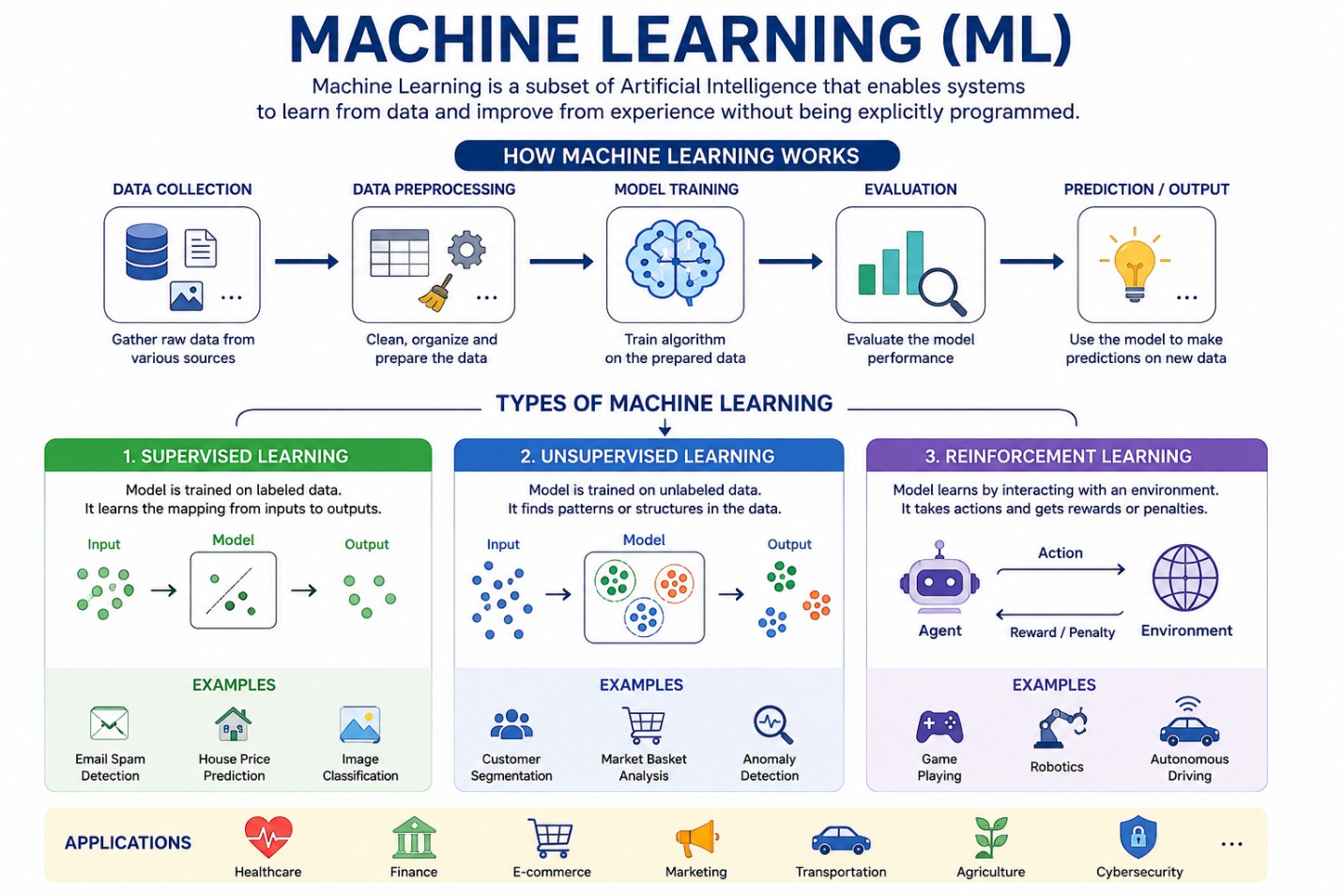
Foundations of Machine Learning
Artificial Intelligence relies heavily on machine learning, a discipline that empowers software systems to learn patterns from raw data and execute predictions autonomously, bypassing the need for manual, hardcoded instructions. Broadly speaking, machine learning strategies are divided into three core paradigms:
Supervised Learning
Unsupervised Learning
Reinforcement Learning
Let’s break down each approach using clear concepts and everyday analogies.
1. Supervised Learning
In supervised learning, algorithms are trained using structured data accompanied by explicit, correct answers (known as labels). Essentially, you provide the system with both the input data and the desired output, allowing it to map out the underlying mathematical relationship.
Practical Scenario: Email Filtering
Imagine building a filter to sort incoming messages into Inbox or Spam. You feed the training model records like:
"You've won a cash prize!" -> Spam
"Quarterly team sync at 2 PM" -> Inbox
Once trained on these examples, the algorithm can accurately evaluate newly arriving emails and categorize them.
Popular Algorithms
Linear & Logistic Regression
Decision Trees & Random Forests
Support Vector Machines (SVM)
K-Nearest Neighbors (KNN)
Artificial Neural Networks
Key Use Cases
Predicting real estate market values
Medical diagnosis and disease screening
Detecting fraudulent credit card transactions
Facial recognition and image categorization
2. Unsupervised Learning
Unsupervised learning deals entirely with raw, unlabeled data. Instead of instructing the model on what to look for, the algorithm autonomously explores the dataset to uncover hidden structures, correlations, or natural groupings.
Practical Scenario: Customer Segmentation
Consider an online retailer analyzing millions of buyer profiles without predefined categories. The system evaluates purchasing habits and automatically sorts buyers into clusters, such as:
Bargain hunters tracking daily discounts
Frequent shoppers buying luxury items seasonally
Occasional visitors purchasing specific household goods
Popular Algorithms
K-Means and Hierarchical Clustering
DBSCAN (Density-Based Spatial Clustering)
Principal Component Analysis (PCA)
Autoencoders
Key Use Cases
Targeted marketing campaigns
Personalized recommendation engines (movies, music, products)
Network security anomaly detection
3. Reinforcement Learning
Reinforcement learning operates on an interactive, trial-and-error philosophy. Instead of learning from a static dataset, an autonomous agent navigates a dynamic environment, executing choices and adjusting its behavior based on rewards or penalties.
Practical Scenario: Autonomous Racing AI
Imagine training an AI agent to drive a digital race car:
Action: The agent steers left or accelerates.
Environment: The racing track simulator.
Feedback: Staying on track grants a +10 reward, while crashing incurs a -10 penalty.
Over countless iterations, the agent refines its internal strategy (policy) to maximize cumulative rewards and master the track.
Core Terminology
Agent: The decision-making entity.
Environment: The context or world the agent interacts with.
State: The current condition or snapshot of the environment.
Action: Choices available to the agent.
Reward: Numerical feedback reflecting the quality of an action.
Policy: The behavioral strategy guiding the agent's decisions.
Key Use Cases
Autonomous driving vehicles
Advanced robotics and manufacturing automation
Strategic game-playing AI (e.g., AlphaGo, chess engines)
Quick Comparison Matrix
A Simple Mental Model: The Classroom Analogy
Supervised Learning: Studying for an exam with an answer key provided by your instructor. You check your answers against the correct solutions as you practice.
Unsupervised Learning: Being handed a massive box of mixed items and sorting them into logical piles entirely on your own without instructions.
Reinforcement Learning: Learning to ride a bicycle. You figure out balance through trial and error—falling down acts as a penalty, while staying upright acts as a reward.