Understanding Recurrent Neural Networks (RNNs): The AI with a Memory
Traditional neural networks—like the ones used to classify images—are fantastic at looking at a single piece of data and making a decision. If you show them a picture of a cat, they tell you it’s a cat.
But standard neural networks have a major blind spot: they have no memory. They treat every single input as completely independent. If you feed them a sequence of words, they forget the first word by the time they process the second.
Imagine trying to read a book, but after every single word, your brain completely wipes its memory. You would never understand the sentence. This is the exact problem Recurrent Neural Networks (RNNs) were built to solve.
How Do RNNs Work?
The magic of an RNN lies in its ability to keep a running context. In software development terms, think of it like maintaining "state" inside a loop.
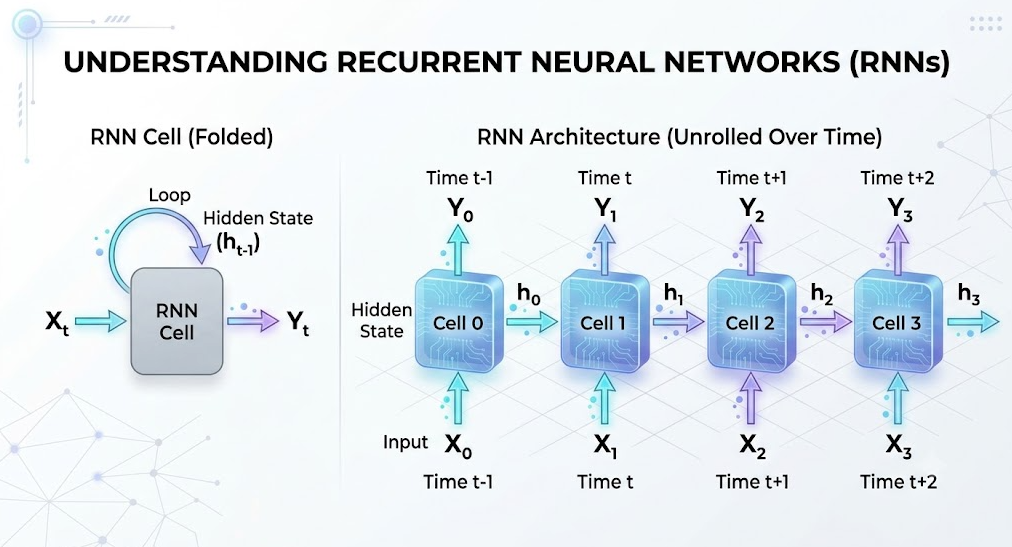
When a standard neural network processes data, information flows strictly in one direction: from input to output. An RNN changes the game by adding a loop. When it processes a piece of data (like the first word in a sentence), it generates an output, but it also generates an internal hidden state—a summary of what it just looked at.
When the network moves on to the second word, it doesn't just look at that new word in isolation. It looks at the new word plus the hidden state from the previous step.
When you "unroll" this loop (as seen in the diagram), an RNN looks like a chain of connected networks passing a message down the line. Every step updates the memory and hands it off to the next step.
Where Do RNNs Shine?
Because they understand the concept of "sequence" and "order," RNNs became the foundational technology for tasks where context matters:
Natural Language Processing (NLP): Figuring out the semantic similarity between two sentences, analyzing sentiment, or translating languages.
Speech Recognition: Converting continuous audio streams into text transcripts.
Time Series Prediction: Forecasting tomorrow's weather or stock prices based on the previous week's patterns.
Predictive Typing: Guessing the next word you are going to type on your phone keyboard.
The Achilles' Heel: The Short-Term Memory Problem
While RNNs sound perfect for sequence data, basic RNNs suffer from a major physical limitation during the training process: they have a terrible long-term memory.
As the network processes a very long sequence—like a massive paragraph of text—the information from the very first few words gets diluted as it gets passed down the chain step after step. By the time the network reaches the end of the paragraph, the memory of the first sentence has effectively vanished.
If an RNN needs context from step 1 to make a decision at step 50, a standard RNN will likely fail to connect the dots.
The Evolution: LSTMs and GRUs
To fix this short-term memory flaw, AI researchers created upgraded versions of the RNN:
LSTMs (Long Short-Term Memory): These networks act like an RNN with a highly selective bouncer at the door. They use internal mechanisms called "gates" to explicitly decide which information is important enough to keep in long-term memory, and which irrelevant information should be thrown away immediately.
GRUs (Gated Recurrent Units): A streamlined, slightly faster variation of LSTMs that achieves very similar results with less computational overhead.
While massive, modern AI systems (like the Transformers powering today's Large Language Models) have largely taken over heavy-duty text generation, RNNs and their variants remain elegant, highly efficient solutions for many sequence-based applications.